
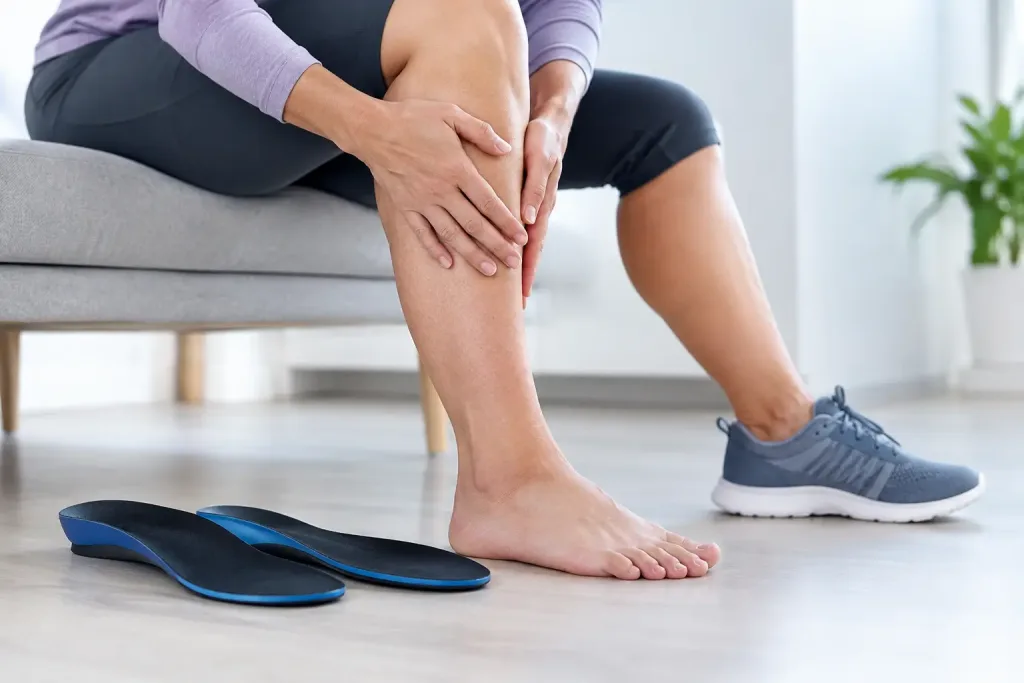
Knee pain is not always a knee-only problem. If your feet roll inward, your arches collapse under load, one leg functions differently from the other, or your footwear no longer supports you, stress can travel upward with every step. Orthotics for knee pain may help by improving how the foot, ankle, leg, and knee work together – but only when they are prescribed for the right reason and fitted to the person wearing them.
For someone who walks on hard floors all day, enjoys recreational running, lives with arthritis, or is trying to stay active despite lower-limb discomfort, the goal is not simply to place a cushion in a shoe. The goal is to reduce avoidable strain while protecting comfort, balance, mobility, and independence.
How foot mechanics can affect the knee
The knee sits between the hip and the foot. It relies on both areas to guide movement efficiently. When the foot contacts the ground, it naturally adapts to the surface and helps absorb force. Problems can arise when that motion is excessive, poorly controlled, or limited in a way that changes the position of the lower leg.
For example, an overly pronating foot may roll inward more than is comfortable or efficient. This can rotate the shin inward and alter the forces passing through the knee. A very high arch can have the opposite pattern: it may be rigid and less effective at absorbing shock. Reduced ankle movement, a leg-length difference, worn-out footwear, and weakness around the foot, hip, or core can also affect the way a person loads the knee.
This does not mean every knee problem starts in the feet. Osteoarthritis, meniscus injuries, inflammatory conditions, tendon injuries, and pain referred from the hip or lower back each need their own assessment. Still, when walking mechanics are contributing to knee strain, addressing the foundation can be a practical part of a broader treatment plan.
When orthotics for knee pain may be useful
Orthotics can be helpful when knee symptoms appear connected to standing, walking, running, work footwear, or a visible change in gait. You may notice that discomfort builds after longer walks, occurs on one side more than the other, or improves temporarily when you wear a more supportive shoe.
They are commonly considered for people with flat or unstable arches, high rigid arches, plantar heel pain, Achilles tendon strain, shin discomfort, recurrent ankle issues, or forefoot pain alongside knee symptoms. In these cases, the same movement pattern may be placing extra demand on more than one area of the lower limb.
People with knee osteoarthritis may also benefit in selected situations. The exact approach depends on where the arthritis and pain are concentrated, how the knee is aligned, and whether the person has enough balance and comfort to adapt to a change in foot support. An orthotic is not a cure for arthritis, but it may reduce aggravating forces during daily activity for some people.
The best results usually come when orthotics are combined with appropriate shoes, activity adjustments, and strengthening or mobility work. A device can guide the foot, but it cannot replace the muscles that support safe movement.
Signs that an assessment is worth considering
An assessment may be useful if knee pain repeatedly follows walking or standing, if shoes wear unevenly, or if you feel unstable on stairs or uneven ground. It is also worth looking at your lower-limb mechanics when foot and knee pain occur together, when one knee consistently hurts more than the other, or when you have changed how you walk to avoid discomfort.
For older adults, changes in gait deserve attention even when pain seems mild. Protecting balance and confidence can help reduce fall risk and support continued independence. People living with diabetes, neuropathy, poor circulation, or previous foot wounds should seek professional guidance before using devices that may create pressure or rubbing inside the shoe.
Custom orthotics versus store-bought inserts
Store-bought insoles can be a reasonable first option for mild, occasional discomfort. They may add cushioning, basic arch support, or a small amount of heel stability. A quality prefabricated insert can be useful for a person whose shoes are otherwise well fitted and who does not have significant deformity, loss of sensation, or complex pain.
Custom orthotics are designed from an individual assessment of foot shape, joint motion, walking pattern, footwear, symptoms, activity level, and medical history. They can be made to provide more targeted support, accommodation for sensitive areas, or specific modifications to influence loading. This is particularly valuable when symptoms are persistent, when both foot and knee mechanics are involved, or when a person has diabetes, arthritis, neurological concerns, or a history of skin breakdown.
Custom does not automatically mean better for everyone. The right choice depends on the problem being treated. A device that is too rigid, too aggressively posted, or poorly matched to the shoe can feel uncomfortable and may move stress elsewhere. This is why professional fitting and follow-up matter as much as the orthotic itself.
What a proper orthotic assessment should include
A thoughtful assessment looks beyond an arch impression or foot scan. It begins with your story: where the pain is located, when it started, which activities provoke it, and what has or has not helped. Your practitioner should also consider your health conditions, work demands, exercise habits, footwear, and goals.
The physical assessment may examine skin integrity, circulation, sensation, joint mobility, muscle strength, leg alignment, balance, and walking pattern. Your shoes can offer useful clues. A compressed midsole, a tilted heel counter, or uneven tread wear may show how your body is loading the ground.
This information helps determine whether an orthotic is appropriate, what type of support is needed, and whether other care should come first. Sometimes the most helpful recommendation is a footwear change, a gradual return-to-activity plan, or referral for medical assessment or physiotherapy rather than an orthotic alone.
Wearing orthotics without creating new problems
Even a well-made orthotic requires an adjustment period. Start with short periods of wear and gradually increase as comfort allows. Some people adapt within days, while others need a few weeks, particularly if the device changes a long-standing movement pattern.
Your orthotics should sit flat inside a supportive shoe with adequate depth and a secure heel. Remove the factory insole only if there is room and the shoe remains comfortable. Avoid forcing an orthotic into a narrow, shallow, unstable, or worn-out shoe. The shoe and orthotic function as a team.
Mild awareness under the arch can be normal early on. Sharp pain, numbness, rubbing, blisters, increased knee pain, or new back or hip symptoms are not signs to push through. Stop wearing the device and arrange a review. People with reduced sensation should inspect their feet daily and report redness or skin changes promptly.
When knee pain needs medical attention first
Orthotics should not delay assessment of a serious knee concern. Seek timely medical care after a significant injury, if the knee is very swollen, hot, red, locked, gives way suddenly, cannot bear weight, or is accompanied by fever. Persistent night pain, unexplained swelling in the calf, new numbness, or rapidly worsening symptoms also need prompt attention.
If knee pain continues despite a reasonable period of conservative care, an assessment can clarify whether imaging, medication, rehabilitation, or specialist care is appropriate. Treating the source of pain matters more than repeatedly changing insoles.
At Feet & Life, an individualized lower-limb assessment can help identify whether foot mechanics are adding unnecessary stress to your knees and whether custom orthotics fit your care plan. Small changes under the feet can make daily movement feel more secure, but the most meaningful outcome is being able to walk, work, exercise, and live with greater comfort and confidence.