
Why would you trust a generic machine at a big-box retail store to solve a complex medical issue like chronic heel pain? If you’ve been struggling with persistent discomfort, you probably realize that a “one-size-fits-all” insert rarely provides more than a few days of relief. It’s frustrating to feel like your mobility is limited by tools that don’t actually account for your unique anatomy or walking patterns. You deserve a solution that’s as individual as your gait.
A professional biomechanical assessment for orthotics Barrie patients receive at a specialized clinic is the vital first step toward lasting comfort. By identifying the specific structural or functional imbalances in your feet and ankles, we can move past guesswork and focus on clinical results. This guide will explain how a practitioner-led evaluation uncovers the root cause of your pain to provide the foundation for custom orthotics that truly change lives. We’ll walk through exactly what happens during a clinical assessment, the difference between medical-grade solutions and retail alternatives, and how understanding your foot mechanics can lead to a future of pain-free movement.
Key Takeaways
- Learn why a professional biomechanical assessment for orthotics Barrie is essential for identifying the precise misalignments that generic retail scans often miss.
- Understand the “kinetic chain” to see how your foot structure directly impacts the health and comfort of your knees, hips, and lower back.
- Discover the five stages of a clinical exam, ranging from a comprehensive medical history to a detailed analysis of joint range of motion.
- Explore how modern 3D laser scanning provides a more accurate map of your foot than traditional methods, ensuring a superior fit for your custom inserts.
- Recognize the value of a nurse-led clinical approach that prioritizes your long-term mobility and integrates foot health into your overall wellness plan.
What is a Biomechanical Assessment for Orthotics?
A biomechanical assessment is a methodical clinical examination of the feet, legs, and overall body mechanics designed to identify structural misalignments. It isn’t just about measuring your shoe size; it’s about understanding the complex relationship between your bones, muscles, and ligaments. For residents seeking a biomechanical assessment for orthotics Barrie, this evaluation provides a professional diagnosis of how your unique anatomy affects your movement and contributes to pain.
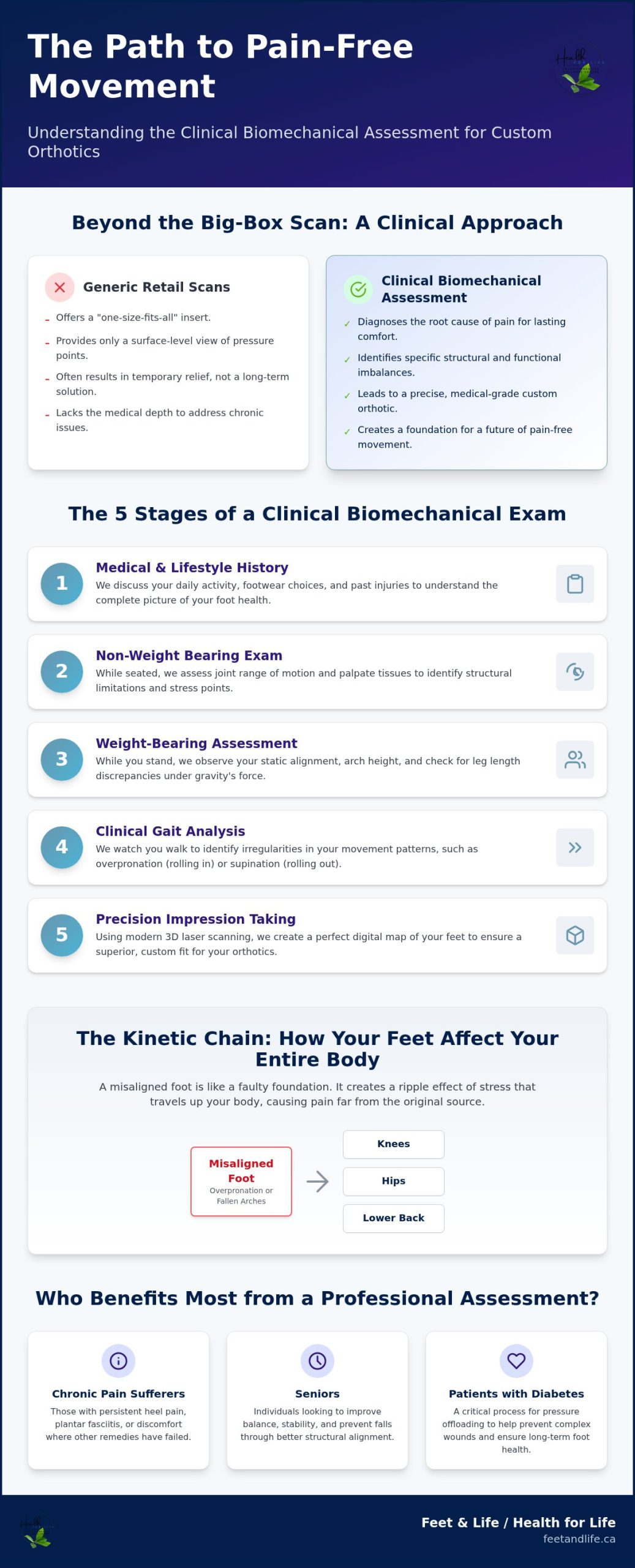
This clinical diagnostic process is the essential first step before any custom orthotic is manufactured. While retail “foot scans” might offer a surface-level view of pressure points, they lack the medical depth needed to address chronic issues. A professional assessment looks beyond the surface to find the root cause of discomfort, ensuring your orthotic inserts are a precise medical intervention rather than a generic cushion. By evaluating how your body moves as a whole, we can develop a plan that addresses your specific clinical needs.
The Science of Lower Limb Biomechanics
Movement is a synchronized effort where every joint must work in harmony. When one element fails, such as with fallen arches or overpronation, where the foot rolls inward excessively, it creates a ripple effect of tissue stress. Supination, or rolling outward, can similarly lead to chronic inflammation and localized pain. A detailed Gait analysis allows us to see these errors in real-time, mapping how biomechanical imbalances lead to the persistent discomfort you feel every day. This scientific approach ensures we aren’t just treating symptoms but are correcting the underlying mechanics of your stride.
Who Benefits from a Professional Assessment in Barrie?
Many people realize they need help only when mobility starts to decline. This assessment is particularly beneficial for those suffering from persistent heel pain or plantar fasciitis, where traditional remedies haven’t worked. Seniors also find great value in these evaluations as they help maintain balance and prevent falls through better alignment. Additionally, for our patients with diabetes, this process is critical. Specialized pressure offloading is a key component of diabetic foot care, helping to prevent the development of complex wounds and ensuring long-term health. Whether you’re an active adult or managing a chronic condition, understanding your mechanics is the first step toward a more comfortable life.
The 5 Stages of a Clinical Biomechanical Exam
A professional biomechanical assessment for orthotics Barrie residents rely on follows a methodical clinical protocol. It isn’t a five-minute process; it’s a deep dive into your physical health. We don’t just look at where it hurts; we look at why it hurts. This structured approach ensures that every custom orthotic we provide is built on a foundation of precise medical data. Our five-stage exam includes:
- Step 1: Comprehensive Medical and Lifestyle History. We discuss your daily activity levels, footwear habits, and any previous injuries that might influence your current movement.
- Step 2: Non-Weight Bearing Physical Examination. While you’re seated, we test joint range of motion and palpate specific tissues to identify areas of stress or restricted mobility.
- Step 3: Weight-Bearing Standing Assessment. We observe your static alignment and arch height while you’re standing to see how your structure handles the force of gravity.
- Step 4: Clinical Gait Analysis. We watch your body in motion to identify irregularities in your walking pattern.
- Step 5: Precision Impression Taking. We use 3D scanning or traditional casting to create a perfect map of your feet in their optimal position.
Non-Weight Bearing vs. Weight-Bearing Analysis
Checking your joint mobility while you’re seated is a critical step that many retail assessments skip. By removing the pressure of your body weight, we can find your “neutral” position and identify structural limitations that aren’t visible when you’re standing. Once we move to the weight-bearing phase, we observe how your arches collapse or shift under pressure. This stage is also where we check for leg length discrepancies. Even a small difference in leg length can lead to significant pelvic tilt and chronic back pain if it isn’t addressed through proper orthotic design.
Gait Analysis: Watching You Move
Walking is a complex cycle that involves the entire body. During your gait analysis, we break down your walk into three distinct phases: the heel strike, the mid-stance, and the toe-off. If your foot rolls too far inward or outward during these phases, it affects The Kinetic Chain, causing a ripple effect of strain through your ankles, knees, and hips. Our nurse-led clinic observes these subtle signs of instability or compensatory movements that automated machines often miss. If you’re tired of walking through discomfort, you can book a consultation at our Barrie clinic to receive a thorough biomechanical assessment for orthotics Barrie and start your journey toward lasting relief.
The Kinetic Chain: How Foot Alignment Affects Your Whole Body
Your body operates as a series of interconnected joints where the movement of one directly influences the function of the next. Undergoing a biomechanical assessment for orthotics Barrie is often the only way to see how a minor foot misalignment creates major issues elsewhere. When your foot alignment is off, the rest of your skeletal structure must compensate to keep you upright and moving. This compensation is what leads to “unexplained” pain in areas far removed from your heels.
Consider the impact of overpronation, a common condition where the arches collapse and the feet roll inward. As the foot rolls, it forces the tibia to rotate, which in turn puts abnormal torque on the knee joint. This isn’t just a foot problem; it’s a mechanical error that stresses the soft tissues of the leg. If left unaddressed, this rotation causes the hip to tilt and the pelvis to shift out of alignment. The result is chronic lower back strain that persists regardless of how many times you treat the back itself. By focusing on the foundation, we can often resolve these complex issues at their source.
Orthotics for Knee and Back Pain Relief
Correcting your foundation is the most effective way to reduce the rotational stress placed on your knees. Custom orthotics provide the specific structural support needed to stabilize the pelvis, which naturally alleviates pressure on the lumbar spine. If you’ve been struggling with discomfort that won’t go away, orthotics for knee and back pain relief can provide the alignment correction that generic solutions miss. We focus on balancing the entire kinetic chain to ensure your joints are no longer fighting against your own anatomy.
Preventing Long-Term Joint Degeneration
The kinetic chain is a mechanical system where the foot serves as the primary stabilizer for the entire skeletal structure. When this stabilizer fails, your joints absorb shock in ways they weren’t designed to handle. Early intervention through a professional biomechanical assessment for orthotics Barrie can slow the progression of osteoarthritis by restoring a natural gait. Maintaining proper alignment today preserves the precious cartilage in your hips and knees, ensuring you stay mobile and active as you age. Our goal is to protect your long-term health through meticulous clinical care and precise mechanical correction.
Assessment Technology: 3D Scanning vs. Traditional Methods
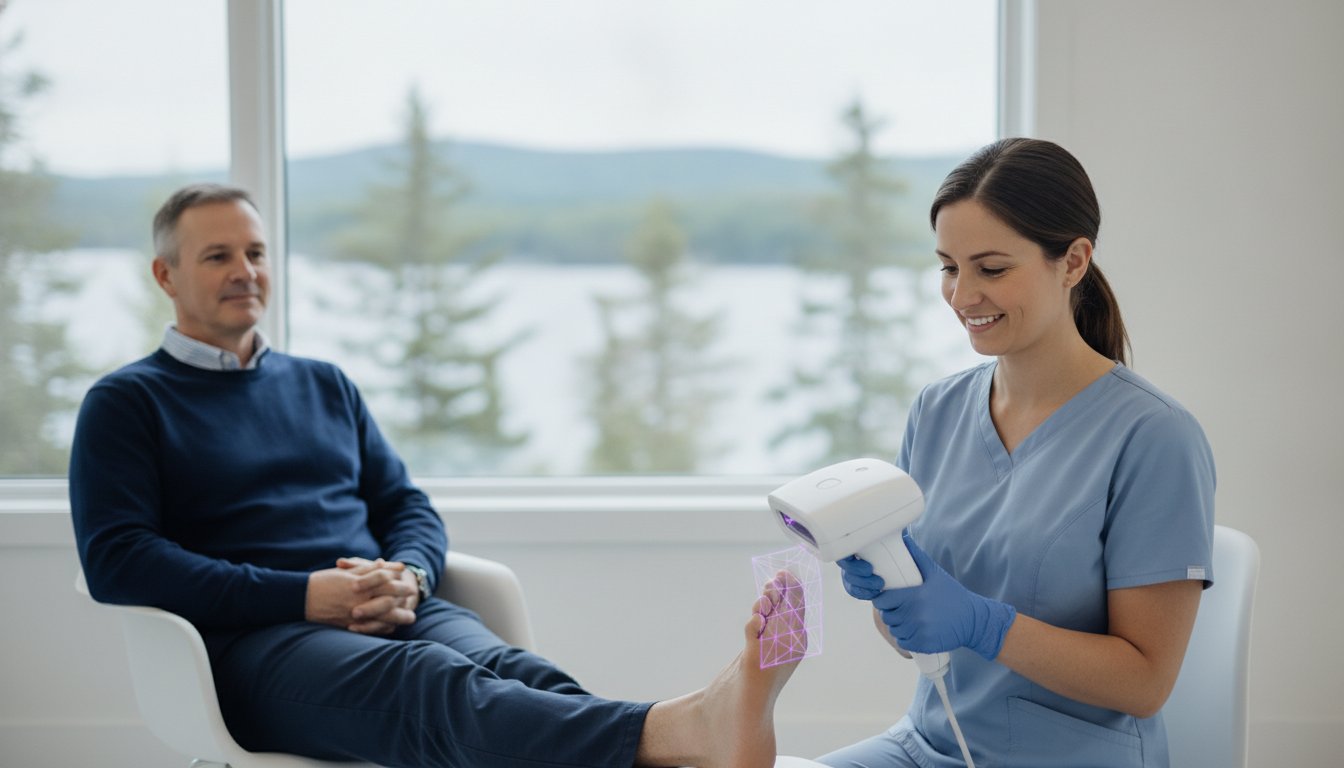
The methods used to capture the unique shape of your feet have evolved from messy plaster casts to high-definition digital precision. While old-fashioned foam boxes were once the standard, they often allowed for foot distortion during the impression process. Today, a biomechanical assessment for orthotics Barrie practitioners perform uses 3D laser scanning to create a sub-millimetre accurate map of your foot’s structural contours. This technology captures the foot in its corrected state, ensuring the final device aligns perfectly with your anatomy.
It’s vital to distinguish these clinical tools from the “pressure mats” found in retail stores. Those mats only capture a two-dimensional surface area of where your foot touches the ground. They don’t account for the height of your arch, the orientation of your heel, or the complex movements of your midfoot. Relying on a 2D scan for a 3D problem is why retail inserts often fail to provide lasting relief. We use clinical data to engineer a prescription that acts as a medical intervention, not just a soft layer of foam.
Why Clinical Accuracy Matters for Custom Inserts
A true custom orthotic is a corrective biomechanical device, not just simple arch support. Its purpose is to maintain the neutral alignment we identify during your physical exam, preventing the compensatory movements that lead to pain. When we achieve this level of accuracy, the device fits more naturally into your daily footwear. Whether you’re wearing work boots, runners, or dress shoes, the orthotic should feel like a natural extension of your foot. Precision scanning at the outset significantly reduces the need for multiple follow-up adjustments, allowing you to return to your daily activities sooner.
What to Bring to Your Assessment Appointment
Preparing for your appointment helps us build a more complete picture of your health. Please bring the shoes you wear most often, as the wear patterns on the soles provide a physical history of your gait. We also recommend bringing any previous orthotics or over-the-counter insoles you’ve tried. Even if they were unsuccessful, they help us understand what hasn’t worked for you in the past. If you have medical referrals or imaging reports related to your foot or leg pain, these documents provide essential context for your clinical care plan. If you’re ready to experience the difference that digital precision makes, book your biomechanical assessment for orthotics Barrie today and take the first step toward better mobility.
The Feet & Life Difference: Clinical Foot Care in Barrie
Choosing where to have your biomechanical assessment for orthotics Barrie is a decision that impacts your long-term mobility and health. At Feet & Life, we distinguish ourselves through a practitioner-led model rooted in a nursing philosophy. Unlike retail environments that focus on shoe sales, our clinic prioritizes clinical safety and overall patient wellness. This medical-first perspective is especially vital for individuals managing complex conditions like diabetic foot care. For these patients, a custom orthotic isn’t just about comfort; it’s a critical tool for pressure offloading and wound prevention that requires professional oversight.
Our expertise extends across the broader Simcoe County area, serving residents in Barrie, Innisfil, Orillia, and Wasaga Beach. We believe that foot health shouldn’t be treated in isolation. That’s why we integrate our orthotic services with other specialized treatments, such as fungal nail laser therapy. This holistic approach ensures that every aspect of your lower limb health is addressed under one roof, with the high standards of care you expect from a medical facility. We don’t just provide a product; we provide a comprehensive health strategy.
Professional Nursing Standards in Foot Health
A nursing background brings a unique level of meticulousness to the clinical environment. In every biomechanical exam, we apply rigorous medical standards to ensure your diagnosis is accurate and your treatment plan is safe. We understand that chronic pain is often a physical and emotional burden. Our clinic provides a reassuring and empathetic space where your concerns are heard and your history is respected. This dedication to detail ensures better long-term outcomes, as we look at the patient behind the symptoms rather than just the mechanics of the feet.
Start Your Journey to Pain-Free Movement
Your first consultation at our Barrie clinic is a thorough, educational experience. We don’t rush the process. Instead, we take the time to explain our findings and show you exactly how your specific mechanics are contributing to your discomfort. We coordinate your care plan to include both custom orthotics and any necessary medical foot care, ensuring a seamless path to recovery. Whether you’re an athlete looking to return to the field or a senior aiming to stay active in the community, we’re here to guide you. Ready to walk with confidence? Book your biomechanical assessment at Feet & Life today and experience a professional approach to foot health.
Step Toward Lasting Mobility and Comfort
Understanding the underlying mechanics of your gait is about more than just finding a comfortable pair of shoes. It’s about stabilizing the foundation of your entire body. By addressing the kinetic chain, a professional evaluation helps resolve chronic pain in the knees and back that generic inserts simply can’t touch. Our nurse-led clinical approach ensures that every patient, especially those requiring specialized diabetic or high-risk foot management, receives care based on meticulous medical standards.
Booking a biomechanical assessment for orthotics Barrie at Feet & Life provides the precise diagnostic data needed to engineer truly life-changing solutions. We serve the broader Simcoe County area with a dedication to superior clinical outcomes and patient wellness. If you’re ready to regain your mobility and walk without discomfort, Schedule Your Professional Biomechanical Assessment in Barrie today. You don’t have to manage foot pain alone; professional, specialized care is available right here in your community.
Frequently Asked Questions
Is a biomechanical assessment for orthotics covered by insurance in Ontario?
Most private insurance plans in Ontario cover these costs, although OHIP does not. You should check your specific policy for details on biomechanical assessment for orthotics Barrie coverage. Many plans require a prescription from a chiropodist or physician to process a claim. Additionally, the Assistive Devices Program (ADP) may cover up to 75% for residents with long-term physical disabilities. We provide the detailed clinical documentation required by providers to ensure your reimbursement is handled efficiently.
How long does a biomechanical assessment appointment take?
A comprehensive clinical evaluation typically takes between 45 and 60 minutes. This timeframe allows us to conduct a thorough medical history review, physical palpation, and a detailed gait analysis. We don’t rush these sessions because meticulous data collection is essential for engineering a precise orthotic prescription. Every patient receives dedicated time to discuss their mobility goals and understand how their specific mechanics contribute to their current discomfort or persistent lower limb injury.
What is the difference between a pedorthist, a chiropodist, and a foot care nurse?
Chiropodists and podiatrists are the primary professions in Ontario with the legal scope to prescribe orthotics. Pedorthists specialize in the manufacturing and fitting of these devices based on those prescriptions. A foot care nurse, like those at our clinic, focuses on the holistic medical management of the foot. We prioritize clinical safety, wound prevention, and the integration of orthotic therapy into your overall wellness and long-term health plan for superior outcomes.
Do I need a doctor’s referral for a biomechanical assessment in Barrie?
You don’t need a doctor’s referral to book a biomechanical assessment at our clinic. Ontario residents can access specialized foot care services directly without seeing a family physician first. However, it’s important to realize that many extended health insurance providers require a physician’s prescription to reimburse the cost of custom orthotics. We recommend checking your insurance policy’s specific requirements before your visit to ensure a smooth and successful claims process afterward.
Can a biomechanical assessment help with back pain even if my feet don’t hurt?
Yes, a biomechanical assessment for orthotics Barrie can identify the root cause of back pain even if your feet feel fine. Because the body operates as a kinetic chain, a minor misalignment in your foundation can force your pelvis to tilt and your spine to compensate. This mechanical imbalance often results in chronic lumbar strain. By stabilizing your foot position, we can alleviate the torque on your back and restore your natural skeletal alignment.
How often should I have my biomechanics re-evaluated?
Most patients should have their biomechanics re-evaluated every one to two years. Your body’s structure and walking patterns can change over time due to age, weight fluctuations, or new injuries. Regular checkups ensure your orthotics still provide the necessary level of correction and support. If you notice new discomfort or if your current inserts show significant signs of wear, you should book an assessment sooner to maintain your daily mobility and comfort.
What should I wear to my biomechanical assessment appointment?
We recommend wearing loose-fitting clothing or shorts that allow us to observe your knees and lower legs clearly during the gait analysis. It’s also essential to bring the footwear you wear most frequently, such as your work boots or daily walking shoes. We examine the wear patterns on these soles to gather clinical evidence about your movement patterns. This information helps us understand how your feet interact with the ground during your normal daily routine.
Will I get my custom orthotics on the same day as my assessment?
No, you won’t receive your custom orthotics on the same day as your assessment. True medical-grade orthotics are engineered in a specialized lab based on the precise 3D scans or casts taken during your appointment. This manufacturing process ensures the device is tailored exactly to your unique anatomy and clinical needs. While the turnaround time varies, this meticulous approach is necessary to provide a high-quality product that offers long-term relief and exceptional durability.