
Did you know that peripheral neuropathy contributes to 78 percent of diabetic foot ulcers? It’s often a “silent” change, making it difficult to realize there’s a problem until a wound appears. If you find it challenging to see the bottom of your feet or feel overwhelmed by clinical terms, you aren’t alone. Many people living with diabetes share your concerns about non-healing infections or the fear of losing their mobility. A professional preventative diabetic foot screening acts as a vital safeguard, identifying hidden circulation and nerve changes before they escalate into serious complications.
This 2026 guide for Barrie residents explains exactly how these specialized exams at a clinical centre protect your independence. You’ll learn what to expect during a professional assessment, how to understand your personal risk level, and why a dedicated partner is essential for long-term health. We’ll also explore how modern solutions, such as custom orthotics, help you maintain a healthy lifestyle while preventing ulcers and infections from the start.
Key Takeaways
- Understand why a professional preventative diabetic foot screening is essential for detecting silent nerve damage that home checks often don’t catch.
- Learn about the specific neurological and vascular tests used to identify risk factors before they lead to serious infections.
- Discover how to determine your personal risk level and the recommended frequency for your clinical foot assessments in 2026.
- Realize why it’s important to have professional oversight for hard-to-see areas like the heel and between toes to prevent hidden complications.
- See how a nurse-led approach and custom orthotics work together to redistribute pressure and protect your long-term mobility.
What is Preventative Diabetic Foot Screening?
A preventative diabetic foot screening is a methodical, clinical assessment used to find early indicators of risk in the lower limbs. It’s much more than a simple visual check. This professional evaluation focuses on identifying the subtle signs of peripheral neuropathy and peripheral vascular disease, two conditions that often go unnoticed by patients in their daily lives. By integrating this screening into your annual health routine in Ontario, you create a defensive barrier against the progression of diabetic complications. The primary objective is simple: we want to prevent the development of non-healing wounds and avoid the life-altering consequences of amputation.
Why Prevention is Critical for Diabetics
Elevated blood sugar levels have a cumulative effect on the body’s systems, particularly the nerves and blood vessels furthest from the heart. Over time, this damage can lead to a loss of protective sensation, meaning you might not feel a stone in your shoe or a blister forming on your toe. This “silent” progression is exactly why Diabetic foot conditions are so dangerous. Without the warning sign of pain, minor irritations can quickly turn into severe infections. High blood glucose specifically impacts the feet in several ways:
- It damages small blood vessels, which reduces the skin’s ability to heal after a minor scrape.
- It impairs nerves, dulling the sensation of heat, cold, or sharp pressure.
- It affects the sweat glands in the feet, often leading to dry, cracked skin that is vulnerable to bacteria.
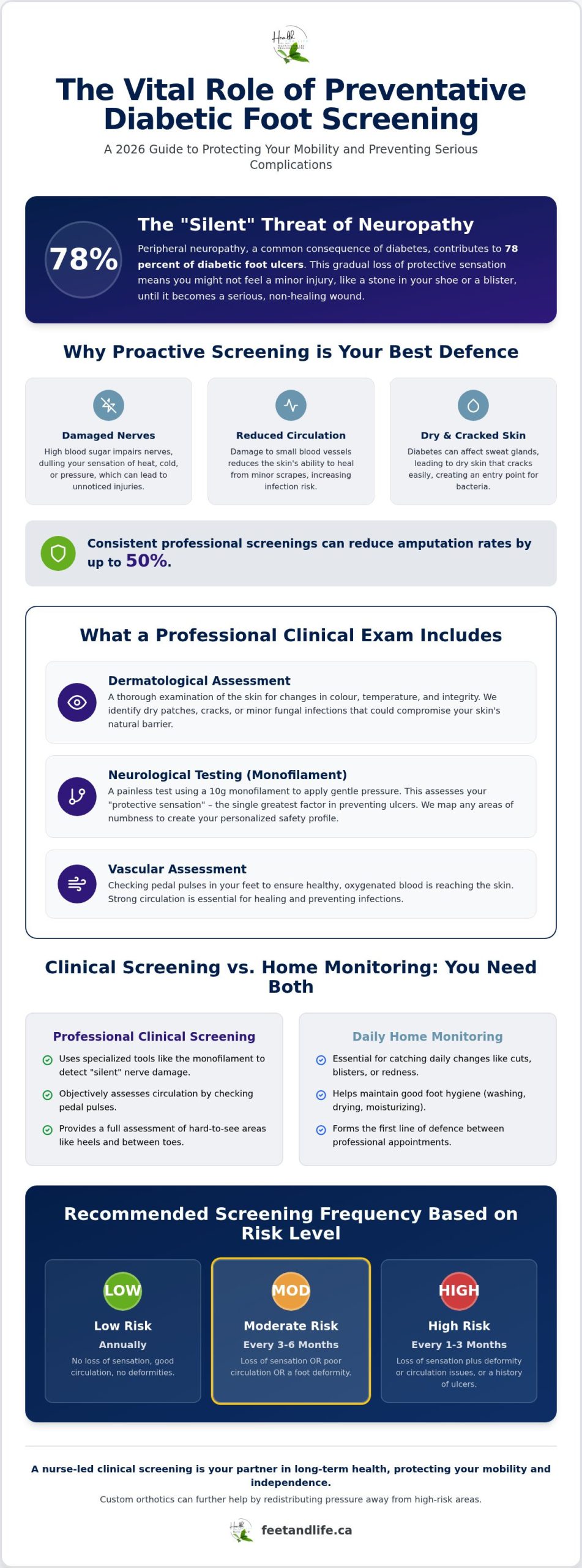
Clinical data suggests that consistent, professional screenings can reduce amputation rates by up to 50 percent. This statistic highlights why a nurse-led, proactive approach is so effective for maintaining your quality of life.
Screening vs. Treatment: Knowing the Difference
Many people confuse screening with the treatment of an existing injury. It’s a distinction that matters for your long-term health. A screening is a diagnostic tool used on feet that may look and feel perfectly fine to the patient. During this process, we look for structural changes, skin temperature variations, and sensory deficits. In our Barrie clinic, we use this time to establish a baseline for your health, allowing us to track changes in your skin integrity and circulation over time.
Treatment, however, is the management of an active problem like an ulcer, a fungal infection, or a wound. You shouldn’t wait for a visible problem to manifest before seeking professional help. Booking a preventative diabetic foot screening allows us to catch risks while they’re still manageable. This methodical approach instills confidence, as you’ll have a clear, documented understanding of your current risk level and a partner to help you navigate your foot health journey.
The Components of a Professional Clinical Foot Exam
A professional preventative diabetic foot screening is a methodical process that goes far beyond a quick visual check. It is a non-invasive, structured evaluation designed to give you a complete picture of your lower limb health. Our nurse-led approach ensures that each step is performed with both clinical precision and a gentle touch. We focus on four core pillars during your visit: dermatological health, neurological function, vascular circulation, and biomechanical structure. This comprehensive view allows us to identify risks that are often invisible during a daily home check.
We begin with a thorough dermatological assessment. We examine the skin for changes in colour, temperature, and integrity. Even a small patch of dry, cracked skin or a minor fungal infection can lead to complications if left unmanaged. By catching these issues early, we help you maintain the skin’s natural barrier against infection.
Neuropathy Testing: Understanding the Monofilament
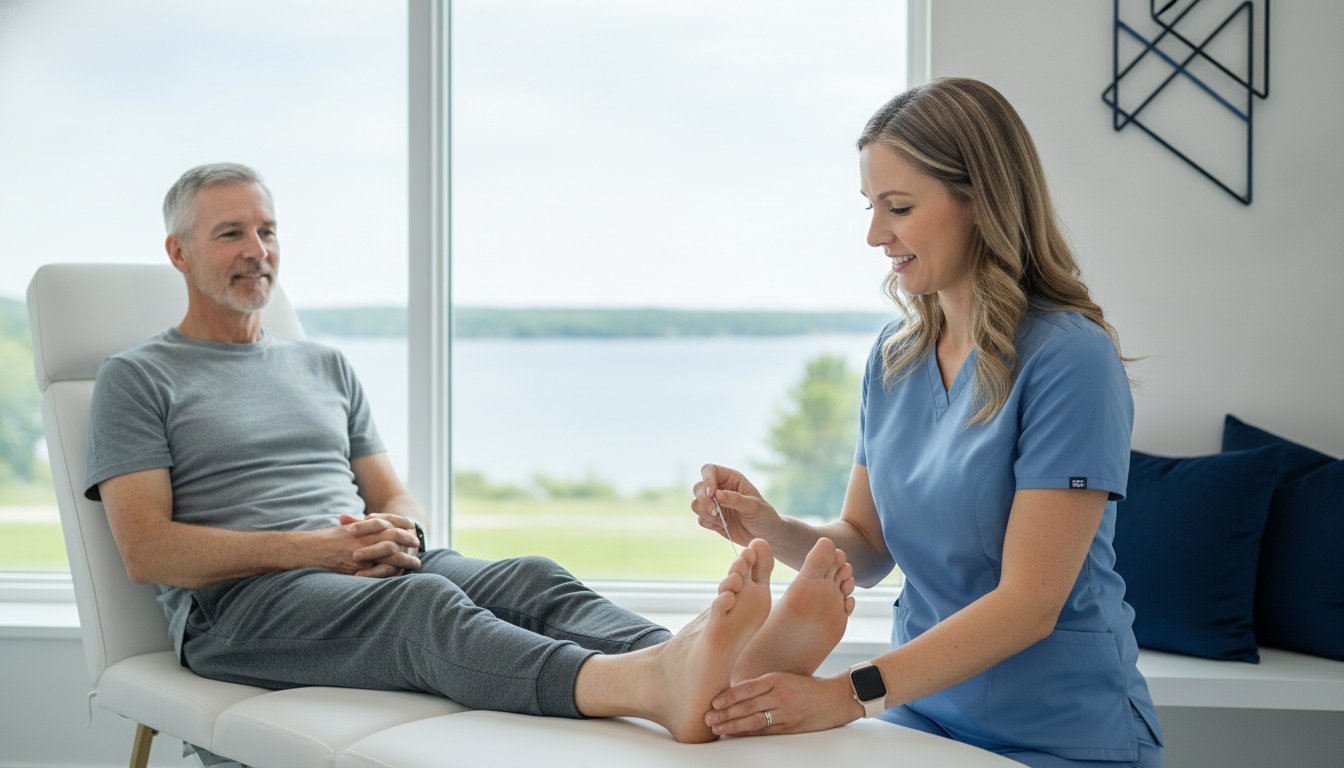
Many patients feel a bit of anxiety when they hear the word “testing,” but this part of the exam is entirely painless. We use a 10g monofilament, which is a small, flexible plastic tool that looks like a thin piece of fishing line. It doesn’t use a needle; it simply applies a specific amount of gentle pressure to various points on your foot. Your job is to let us know when you feel it. This helps us determine if you still have “protective sensation.”
Losing this sensation is the single greatest risk factor for developing a diabetic foot ulcer. If you can’t feel a small stone or a blister, your body won’t signal you to take action. During the screening, we map any areas of numbness to provide you with a personalized safety profile. This knowledge empowers you to be more vigilant in specific areas of your feet.
Circulation and Vascular Health
Healthy blood flow is essential for the skin to repair itself. During your assessment, we check your pedal pulses to ensure that oxygenated blood is reaching your extremities effectively. We also look for signs of Peripheral Arterial Disease (PAD), such as persistent coldness, thin or shiny skin, and loss of hair on the toes. If you’ve noticed your feet feel unusually cold or look pale, it’s a good time to consider professional diabetic foot care to verify your vascular health.
Finally, we perform a biomechanical review. We look for structural changes like bunions, hammer toes, or high arches that might be creating high-pressure zones. These areas are prone to calluses, which can break down into wounds over time. Identifying these pressure points early allows us to discuss preventative strategies, such as custom orthotics, to redistribute your weight and keep you moving comfortably.
Clinical Screening vs. Home Monitoring: Why You Need Both
Managing diabetes requires a two-tiered approach to foot health. Your daily home checks serve as an early warning system, while a professional preventative diabetic foot screening provides the deep diagnostic insight needed to prevent long-term complications. While you are the expert on how your feet feel day-to-day, a nurse-led clinical exam identifies structural trends and “silent” changes that often go unnoticed during a routine mirror check. This partnership ensures that minor issues don’t escalate into significant health challenges.
What to Look for During Your Daily Home Check
Daily monitoring is your first line of defence. It’s best to perform this check at the same time every day, perhaps before putting on your socks in the morning or after taking them off at night. You should use a mirror or ask a family member for help if you have difficulty seeing the bottom of your feet. Look for the following indicators:
- Redness or swelling: New spots of colour that don’t fade after you rest your feet.
- Blisters or cuts: Even minor abrasions require immediate attention to prevent infection.
- Temperature changes: Areas that feel unusually warm or cold to the touch compared to the surrounding skin.
- Nail changes: Look for thickening, discolouration, or edges that appear to be ingrowing.
Don’t forget to inspect the inside of your shoes for foreign objects like small pebbles, grit, or torn linings that could cause friction. For those already experiencing sensation changes, our guide on managing diabetic neuropathy foot care offers deeper insight into protecting your feet when your natural warning signals are diminished.
The “Blind Spots” of Self-Examination
Physical limitations often make it difficult to see the back of the heel or the narrow spaces between the toes. These are common sites for fungal infections and pressure wounds. During a clinical screening, we use specialized tools to quantify nerve loss and circulation levels in ways a home check cannot. This allows us to identify “pre-ulcerative” lesions. These are areas of high stress where the skin is still intact, but the tissue underneath has begun to break down due to excessive pressure.
A frequent “blind spot” for patients is the presence of calluses. While many people view a callus as “just a corn” or a patch of tough skin, in a diabetic foot, it acts as a hidden pressure indicator. A thick callus increases the force on the underlying skin, behaving much like a pebble trapped inside your shoe. Our professional biomechanical assessment identifies these future risk zones. We then work with you to develop strategies, such as the use of custom orthotics, to offload that pressure and keep your skin healthy. This methodical approach helps you realize the full picture of your foot health and maintain your long-term mobility.
Identifying Your Risk Level and Screening Frequency
Risk levels aren’t permanent labels; they’re clinical tools that help us organize your care. A preventative diabetic foot screening allows us to place you in a category that ensures you receive the right level of attention at the right time. This methodical approach is based on the 2026 standards of care, ensuring you never feel lost in your health management plan. Your personal risk level dictates how often we need to see you to maintain your mobility and prevent complications.
- Low Risk: If you have full sensation and no structural deformities, an annual screening is usually sufficient. This visit confirms that your circulation remains stable and your skin integrity is healthy.
- Moderate Risk: When we detect early signs of neuropathy or structural changes like bunions or hammer toes, we increase frequency to every 3 to 6 months. This allows us to monitor pressure points before they break down.
- High Risk: For those with a previous history of ulcers or an amputation, we often recommend monthly or bi-monthly visits. This high level of vigilance is necessary to protect the remaining tissue and prevent new infections.
When to Increase Your Screening Frequency
Changes in your health or lifestyle can shift your risk level between scheduled visits. It’s essential to recognize the signs of high-risk changes, such as Charcot foot. This condition involves a sudden weakening of the bones in the foot, often presenting as redness, swelling, and warmth without significant pain. If you notice these symptoms, or if new calluses begin to form rapidly, you should contact us to adjust your schedule. As you age, your skin naturally thins and circulation may slow, making it vital to consult with a professional to realize when a more frequent care plan is needed.
Custom Orthotics as a Preventative Tool
One of the most effective ways we manage moderate to high risk is through the use of custom orthotics. These aren’t just simple insoles; they’re precision-engineered medical devices designed to redistribute your body weight away from vulnerable areas. By correcting your alignment, we can prevent the friction that leads to high-risk calluses. Just as we use orthotics for plantar fasciitis Barrie to manage mechanical strain, we utilize them in diabetic care to offload pressure and maintain skin integrity. If you’re ready to establish your personal care plan, you can book an assessment at Feet & Life today.
Preventative Care at Feet & Life: The Nurse-Led Difference
Choosing a provider for your preventative diabetic foot screening is a significant decision for your long-term health. At Feet & Life, we offer a specialized environment that bridges the gap between high-level medical expertise and empathetic, patient-centered care. Our clinic is led by a nursing philosophy that prioritizes your comfort and quality of life above all else. We focus on non-invasive medical foot care, ensuring that every assessment is thorough yet gentle. By coordinating our findings with your family doctor or diabetes care team, we create a unified front against potential complications.
One of the unique advantages of our Barrie clinic is how we integrate clinical data into practical solutions. If your screening reveals high-pressure areas or structural changes, we don’t just identify the problem; we provide the remedy. The results of your vascular and neurological tests directly inform the design of your custom orthotics. These devices are precision-crafted to offload pressure from vulnerable tissues, effectively acting as a preventative shield for your feet. This seamless transition from diagnosis to protection is a hallmark of our dedicated approach.
Our Caring Approach to Diabetic Health
A nurse-led clinic offers a level of attentive care that is often missing in broader medical settings. We believe that education is the most powerful tool in your health arsenal. During every preventative diabetic foot screening, we take the time to explain the clinical terminology and what your specific results mean for your daily routine. We don’t rush through appointments; instead, we move at a steady, methodical pace that allows you to ask questions and feel fully informed. This approach transforms a clinical necessity into a stable, long-term partnership focused on your wellness and independence.
Booking Your Screening in Barrie and Simcoe County
Accessing specialized foot care should be straightforward. You don’t need a referral from your family doctor to book a medical foot health consultation with our team. We serve the wider Barrie and Simcoe County community, providing a reliable pillar of support for those living with diabetes. When you arrive for your first appointment, please bring the footwear you use most often and a current list of your medications. This information helps us build a comprehensive safety profile tailored to your specific needs. Taking this proactive step today ensures you stay mobile for years to come.
Schedule your professional foot pain assessment in Barrie today.
Securing Your Mobility Through Proactive Care
Maintaining your independence starts with realizing that foot health is a dynamic process. While daily home checks are a vital habit, they’re only half of the protective equation. A professional preventative diabetic foot screening provides the clinical data needed to identify “silent” risks like neuropathy or reduced circulation before they threaten your quality of life. By determining your specific risk level, you can organize a care schedule that fits your needs and prevents the progression of ulcers or infections.
At Feet & Life, we combine specialized nurse-led expertise with a deeply reassuring approach to support Barrie and Simcoe County residents. We specialize in non-invasive medical foot care designed to keep you moving comfortably. You don’t have to navigate these health complexities alone; a dedicated partner makes all the difference in achieving superior outcomes. Book Your Preventative Diabetic Foot Screening at Feet & Life today to safeguard your future mobility. We’re here to provide the meticulous care and education you deserve.
Frequently Asked Questions
Is a preventative diabetic foot screening painful?
A preventative diabetic foot screening is entirely non-invasive and painless. We use gentle diagnostic tools, such as the 10g monofilament, which feels like a light touch rather than a needle. Our nurse-led approach ensures you feel comfortable and relaxed throughout the session. The goal is to gather accurate data about your nerve health and circulation without causing any distress or discomfort to your feet.
How often should I have a professional foot exam if I have diabetes?
Your screening frequency depends on your personal risk level as determined during your initial clinical assessment. Low-risk patients generally require an annual visit to maintain a healthy baseline. If you have moderate risk factors like neuropathy, we recommend a check every 3 to 6 months. High-risk individuals with a history of ulcers or structural changes should be seen monthly or bi-monthly to ensure safety.
Can I perform a preventative diabetic foot screening myself?
You cannot perform a clinical screening yourself because it requires specialized diagnostic tools and medical training. While daily home checks are essential for spotting immediate changes like redness or cuts, they cannot quantify nerve loss or measure pedal pulses accurately. A professional screening uses methodical testing to identify “pre-ulcerative” lesions and structural trends that are often invisible to the untrained eye during a mirror check.
Will my insurance cover preventative diabetic foot care in Ontario?
In Ontario, routine preventative diabetic foot care is not covered by OHIP. However, many Barrie residents find that their extended health benefit packages or private insurance plans provide coverage for services delivered by a registered nurse or chiropodist. It’s always a good idea to verify your specific plan details with your provider before your appointment to understand your available wellness benefits for specialized lower limb health.
What is the most common sign of a diabetic foot problem?
The most common indicator of a potential issue is peripheral neuropathy, which often presents as numbness, tingling, or a “pins and needles” sensation. You might also notice skin changes such as persistent redness, unusual warmth, or the rapid formation of calluses on pressure points. Because these symptoms can be subtle or entirely painless, regular professional monitoring is necessary to catch them before they lead to complications.
What should I do if I find a small cut or blister on my foot?
If you discover a cut or blister, you should clean the area with mild soap, apply a sterile dressing, and contact a professional immediately. Because diabetes can slow the healing process and dull pain, even a minor abrasion can escalate quickly if left unmanaged. Avoid using “bathroom surgery” or over-the-counter medicated corn plasters, as these can damage sensitive skin and increase your risk of infection.
Does a diabetic foot screening include nail care?
Yes, a comprehensive medical foot care session at our clinic often includes professional nail trimming and the management of thickened or fungal nails. While the screening itself is a diagnostic assessment of your risk level, we integrate therapeutic care to ensure your feet remain healthy. Proper nail maintenance is a critical part of prevention, as it reduces the risk of ingrown nails or skin irritation.
How do custom orthotics help with diabetic foot prevention?
Custom orthotics are a powerful preventative tool because they redistribute your body weight away from high-pressure zones. By providing better alignment and cushioning, they reduce the friction that causes calluses to form. Since calluses often hide underlying tissue breakdown, using orthotics to offload these areas significantly lowers your risk of developing a diabetic foot ulcer. They help you maintain an active lifestyle while protecting your skin’s integrity.