
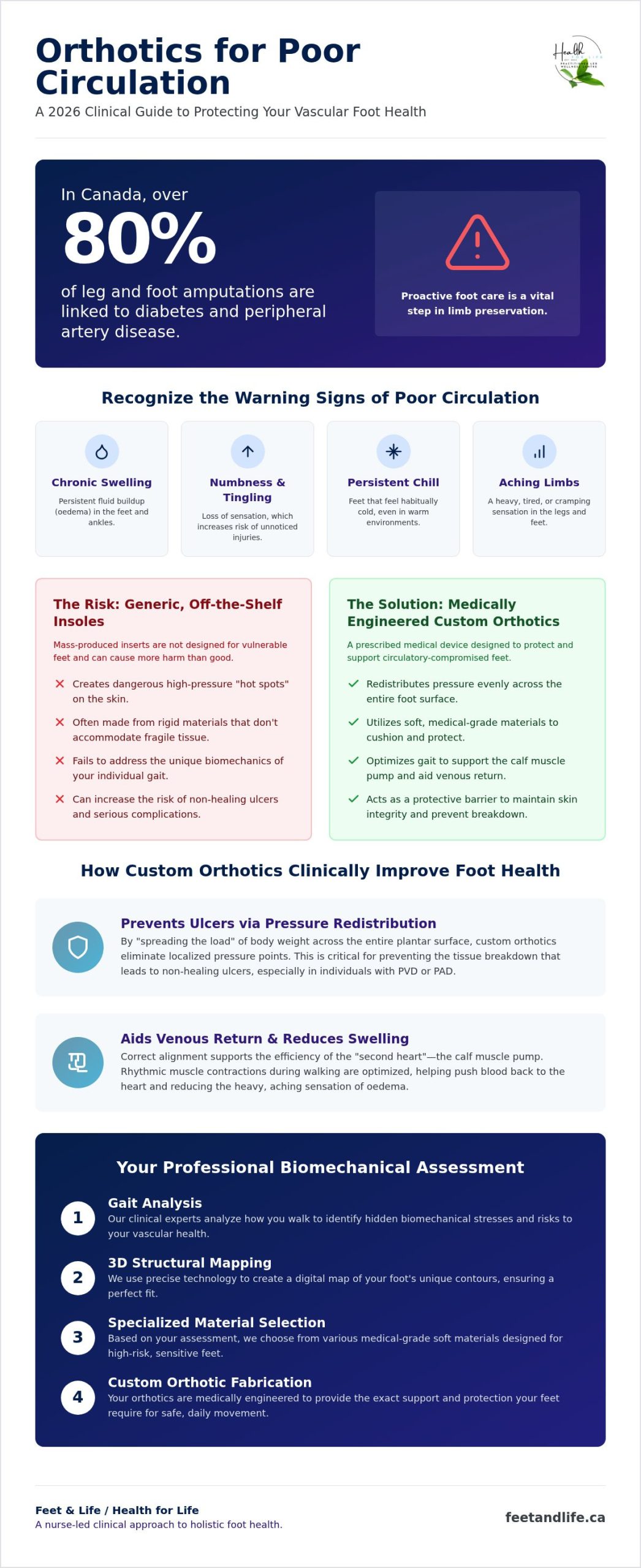
Did you know that diabetes and peripheral artery disease contribute to over 80 percent of leg and foot amputations across Canada? It’s a sobering reality for many residents in our community who live with the daily discomfort of chronic swelling, numbness, or the persistent chill of poor blood flow. You likely understand the frustration of heavy, aching limbs and the underlying worry that a small blister could become a serious clinical complication. Choosing the right orthotics for poor circulation Barrie practitioners prescribe is about more than just comfort; it’s a vital step in proactive medical foot care.
We’re here to show you how medically engineered custom orthotics can serve as a powerful tool to improve lower limb circulation, manage swelling (oedema), and protect high-risk skin from breakdown. This 2026 guide explores the clinical relationship between precise pressure redistribution and vascular health. You’ll learn what to expect from a professional biomechanical assessment at our clinic and how specialized materials can transform your mobility while safeguarding your long-term wellness.
Key Takeaways
- Understand how medically engineered pressure redistribution prevents tissue damage and supports the body’s natural venous return.
- Learn why custom orthotics for poor circulation Barrie clinics provide are essential for managing chronic swelling and protecting against non-healing ulcers.
- Discover the critical differences between soft and hard orthotic materials when designing solutions for high-risk, circulatory-compromised feet.
- Prepare for your professional biomechanical assessment by understanding how gait analysis identifies hidden risks to your vascular health.
- Explore how a nurse-led clinical approach integrates orthotic therapy with specialized wound management for a holistic health strategy.
The Critical Link Between Foot Circulation and Orthopaedic Support
Blood flow is the lifeblood of tissue health. When circulation to the lower limbs is restricted, the feet become vulnerable to even the slightest friction or pressure. Peripheral Vascular Disease (PVD) and Peripheral Arterial Disease (PAD) are clinical conditions where narrowed blood vessels reduce the delivery of oxygen and nutrients to the extremities. This isn’t just a matter of feeling a bit of a chill; it significantly compromises the skin’s ability to repair itself. For those seeking orthotics for poor circulation Barrie practitioners often emphasize that structural support must be paired with vascular awareness to prevent long-term complications. Ignoring these changes can lead to a dangerous cycle of tissue breakdown and infection.
Understanding Peripheral Vascular Disease (PVD) in the Feet
PVD often presents quietly before causing significant pain. You might notice your feet feel habitually cold, or perhaps you’ve seen a bluish or pale discolouration in your toes. Small scratches or blisters that used to heal in days may now linger for weeks. These are clear signals that your skin is struggling to maintain its integrity. Because reduced blood flow thins the skin and reduces its elasticity, it cannot handle the same mechanical stress as healthy tissue. Barrie residents living with diabetes must be especially vigilant. In Canada, diabetes and peripheral artery disease are responsible for over 80 percent of leg and foot amputations. This statistic underscores why a professional clinical assessment is far more than a simple footwear fitting; it is a vital step in limb preservation.
Why Custom Support Outperforms Generic Insoles
Standard, mass-produced footwear and generic inserts are designed for the “average” foot, but they often fail those with circulatory challenges. Off-the-shelf inserts are typically made from rigid materials that can create new, high-pressure “hot spots” rather than relieving them. For a patient with poor circulation, a single point of excessive pressure can quickly lead to a non-healing ulcer. To understand the broader medical context of these devices, one might ask: What are orthotics? In a clinical sense, they are external devices used to modify the structural and functional characteristics of the neuromuscular and skeletal system.
Custom-moulded orthotics for poor circulation Barrie patients receive at our clinic are different because they respect the unique contours of the individual foot. By using softer, medical-grade materials and precise 3D mapping, we can redistribute weight across the entire plantar surface. This methodical approach ensures that no single area of the foot is overworked. Proper alignment also supports the efficiency of the calf muscle pump, which is essential for returning blood to the heart and reducing the heavy, aching sensation of oedema. Custom devices act as a protective barrier, maintaining skin integrity and providing the stability needed for safe, daily movement.
How Custom Orthotics Improve Blood Flow and Reduce Swelling
Custom-engineered foot supports do far more than provide a soft surface for walking. They serve as a sophisticated medical intervention that manages the internal environment of the lower limb. For those utilizing orthotics for poor circulation Barrie residents often find that professional devices can actually assist the body’s natural vascular processes. By optimizing the way the foot interacts with the ground, we can influence how blood moves through the vessels and how fluid is managed within the tissues.
Pressure Redistribution: The Key to Preventing Ulcers
When circulation is compromised, particularly in cases of Peripheral Artery Disease (PAD), the skin becomes fragile. A biomechanical assessment allows us to identify “hot spots” where your unique bone structure creates excessive friction against your footwear. Custom orthotics are designed to “spread the load” across the entire plantar surface, ensuring that no single area bears the brunt of your body weight. Pressure offloading is a clinical necessity for circulatory health because it prevents the localized tissue death that occurs when blood flow is restricted by mechanical weight. By protecting these vulnerable tissues, we significantly reduce the risk of developing non-healing ulcers that often lead to more severe medical interventions.
Aiding Venous Return Through Gait Optimization
The legs are often called the “second heart” because of the calf muscle pump. This mechanism relies on the rhythmic contraction of muscles during walking to push blood and lymphatic fluid back up toward the torso. If your gait is inefficient due to poor foot alignment, this pump doesn’t work at its full potential. This inefficiency often leads to the “heavy leg” feeling and persistent oedema (swelling) that many patients experience. Orthotics stabilize the foot, ensuring that every step is mechanically sound and that the calf muscles engage effectively. This consistent, anatomically correct support helps move stagnant fluid, reducing swelling and the associated discomfort of tight, stretched skin.
Beyond the major vessels, proper support also protects the micro-circulation within the foot. Reducing mechanical stress on the tiny capillaries allows for better nutrient exchange at the cellular level. If you’ve noticed your feet feeling increasingly numb or heavy, a professional clinical assessment can identify if your current footwear is contributing to these circulatory challenges. Addressing these issues early through specialized orthotics for poor circulation Barrie patients trust can prevent the progression of skin breakdown and improve your overall quality of life.
Comparing Orthotic Solutions for High-Risk Feet in Barrie
Selecting the right orthotics for poor circulation Barrie residents need involves more than just choosing a comfortable insert. For high-risk feet, the clinical intent behind the device must shift from rigid correction to accommodative protection. While many retail outlets focus on arch support for the general population, patients with compromised blood flow require a specific combination of material science and anatomical precision. We prioritize the preservation of skin integrity and the management of mechanical stress, ensuring your footwear becomes a partner in your vascular health rather than a source of irritation.
Material Science: Choosing the Right Top Covers
The interface between your foot and the orthotic is where most complications begin. For individuals with slow-healing skin, we often utilize Plastazote, a specialized closed-cell foam that is widely considered the gold standard for high-risk foot care. This material is designed to “bottom out” or mould specifically to the high-pressure areas of your foot, effectively self-customizing as you walk to reduce shear forces. Friction is a primary catalyst for skin breakdown; therefore, choosing a top cover with low-friction properties is essential. We also select materials with antimicrobial treatments to help prevent infections, which is a critical concern for those whose bodies cannot mount a rapid healing response. Breathability is another non-negotiable feature, as moisture trapped against the skin can soften the tissue and make it more susceptible to tearing.
The Clinical Assessment vs. The Retail Fitting
It is vital to distinguish between a retail shoe fitting and a professional biomechanical foot assessment. A retail environment often relies on “scanned and shipped” technology that captures a 2D or 3D image but ignores your underlying medical history or circulatory status. Our nurse-led approach ensures that your orthotics are part of a broader medical foot care plan. We monitor for subtle changes in skin colour, temperature, and pulse strength during your consultation. This clinical oversight is what prevents the “orthotic trap,” where a rigid device prescribed by a non-specialist actually causes the very ulcers it was meant to prevent. By choosing a practitioner who understands the complexities of orthotics for poor circulation Barrie patients can rest assured that their devices are designed with a deep understanding of their specific vascular needs.
Your Biomechanical Assessment in Barrie: What to Expect
A professional clinical assessment at Feet & Life is a comprehensive evaluation that distinguishes itself from a standard retail fitting by its medical depth. When we prescribe orthotics for poor circulation Barrie residents receive a device backed by a thorough understanding of their specific vascular and structural needs. This process is not about finding a shoe that fits; it’s about engineering a medical solution that protects your tissue and enhances your mobility. We take the time to understand your unique health profile before any design work begins.
Step 1: Clinical History and Circulatory Review
Our nurse-led approach starts with a detailed discussion of your medical history, focusing on conditions like diabetes or heart health that directly impact blood flow. We pay close attention to any history of foot wounds or persistent swelling. During the physical exam, we check your pedal pulses and assess skin temperature to establish a baseline for your vascular health. This step is essential for identifying specific mobility goals and pain relief targets. By understanding where your circulation is most compromised, we can design your orthotics to prioritize the areas that need the most protection.
Step 2: Biomechanical Gait Analysis
How you move determines how your body manages pressure. We use clinical observation to identify subtle imbalances in your walking pattern that might be restricting blood flow or creating dangerous friction points. Your foot alignment affects your entire lower limb, influencing the efficiency of the muscles responsible for venous return. We explain these findings in plain language, ensuring you understand exactly how your structural mechanics are impacting your circulatory health. This transparency helps you become an active participant in your own care plan.
Once the analysis is complete, we use precision mapping to capture the exact geometry of your foot. This ensures the final device provides the protective offloading necessary for high-risk tissues. Our care doesn’t end when you receive your orthotics; we provide consistent follow-up and adjustments to ensure the devices evolve with your needs as your circulation or activity levels change. If you are ready to prioritize your long-term foot health, you can book your biomechanical assessment with our clinical team today.
Feet & Life: Specialized Care for Circulatory Foot Health
At Feet & Life, we believe that medical foot care requires more than just a technical solution; it demands a patient-centred, clinical perspective. Our nurse-led philosophy ensures that every patient is viewed as a whole person, not just a pair of feet. When prescribing orthotics for poor circulation Barrie residents can trust that their care is grounded in deep medical expertise. This approach is particularly vital for those requiring diabetic wound care, where the margin for error is slim and the need for precision is high. We bridge the gap between high-level medical knowledge and compassionate, daily wellness.
A Practitioner-Led Focus on Wound Prevention
Our specialization in non-invasive medical treatments makes us a unique resource for our community. We are often the preferred choice for foot care for seniors in Barrie because we understand the specific challenges that age-related circulatory decline brings. Our goal is always to prevent complications before they start. By monitoring skin integrity and vascular health alongside orthotic therapy, we provide a layer of safety that generic retail fittings simply cannot match. We’re committed to your long-term wellness, ensuring that you remain mobile and independent for as long as possible. We don’t just provide a device; we provide a dedicated health partner.
Convenient Local Care in Simcoe County
Located in the heart of Barrie, our clinic serves as a stable pillar for the surrounding Simcoe County area. We’ve designed our practice to be accessible and inviting, removing the barriers to high-quality clinical care. Whether you’re managing a chronic condition or simply want to improve your lower limb comfort, our team is here to guide you. We understand that your time is valuable, so we’ve streamlined our booking process to be as simple as possible for both new and returning patients. Taking the first step toward better health shouldn’t be a struggle.
Professional orthotics for poor circulation Barrie patients rely on are just one part of our comprehensive health strategy. We invite you to experience the difference that a dedicated, nurse-led clinical team can make for your quality of life. Our methodical, thorough approach ensures that no detail is overlooked in your care plan. Book your clinical foot assessment at Feet & Life today and secure the expert care your feet deserve.
Securing Your Mobility and Vascular Health
Managing circulatory challenges requires a proactive approach that prioritizes tissue protection and mechanical efficiency. We’ve explored how medically engineered pressure offloading prevents the development of non-healing ulcers and how proper alignment supports the body’s natural venous return. Unlike generic retail inserts, specialized orthotics for poor circulation Barrie patients receive at our clinic are designed through a rigorous clinical lens. Our nurse-led team combines specialized wound management expertise with advanced biomechanical analysis to ensure your devices provide the highest standard of care.
Serving the Barrie and Simcoe County community, Feet & Life remains dedicated to improving your quality of life through meticulous, non-invasive medical foot care. We invite you to take a decisive step toward safeguarding your long-term mobility. By choosing a practitioner-led assessment, you’re investing in a stable future where your foot health is managed with precision and compassion. Professional oversight ensures that your treatment plan evolves alongside your health needs, providing security and peace of mind.
Book Your Professional Foot Assessment in Barrie and let us help you move with confidence.
Frequently Asked Questions
How do I know if my foot pain is caused by poor circulation?
Indicators of circulatory pain include persistent coldness, cramping during activity, and skin discolouration. Unlike structural pain, which is often sharp or localized, vascular discomfort frequently presents as a heavy or numb sensation. A professional clinical assessment is the only definitive way to determine if your symptoms relate to vascular health or biomechanical stress.
Can custom orthotics really help reduce foot swelling (oedema)?
Yes, custom devices aid in fluid management by optimizing your gait and supporting the calf muscle pump. When your foot is properly aligned, your muscles contract more efficiently during movement. This improved mechanics helps push stagnant fluid back toward the heart, reducing the persistent heaviness and tightness associated with chronic lower limb swelling.
Is it safe to wear orthotics if I have diabetic neuropathy?
It’s safe and often medically necessary when the devices are custom-made by a specialist. Patients with neuropathy lose the sensation of pain, making them prone to silent injuries. Custom orthotics for poor circulation Barrie practitioners design specifically for high-risk feet use soft, accommodative materials to prevent the friction that causes silent tissue breakdown and ulcers.
How often should I have my circulation checked by a foot specialist in Barrie?
High-risk patients should typically have a professional vascular and skin check every three to six months. If you have a history of ulcers or significant Peripheral Artery Disease, more frequent monitoring may be required. Regular visits allow our clinical team to detect subtle changes in skin temperature or pulse strength before they become serious concerns.
What materials are best for orthotics if I have sensitive skin?
Medical-grade materials like Plastazote or specialized closed-cell foams are ideal for sensitive or compromised skin. These materials are accommodative, meaning they mould to the foot’s shape and redistribute pressure away from bony prominences. They also offer antimicrobial properties and superior breathability to maintain a healthy, dry environment within your footwear.
Do I need a referral to get custom orthotics at Feet & Life?
You don’t need a physician’s referral to book a consultation at our clinic. However, many private insurance providers in Ontario require a prescription from a doctor or a chiropodist to process your claim. We recommend checking your specific policy details before your appointment to ensure you have the necessary documentation for insurance reimbursement.
How long does it take to get used to orthotics for circulation?
Most patients require a break-in period of approximately two weeks to adjust to their new devices. Because orthotics for poor circulation Barrie clinics provide are often softer and more accommodative than rigid sports orthotics, the transition is usually quite gentle. We provide a structured wear schedule to help your tissues adapt without causing new pressure points.
Will insurance in Ontario cover custom orthotics for circulatory issues?
Most private health insurance plans in Ontario provide partial or full coverage for custom-made medical orthotics. While OHIP does not cover these devices for general outpatient use, employer-sponsored plans often provide between C$300 and C$600 in coverage. You’ll typically need a biomechanical assessment report and a detailed invoice to submit a successful claim for your devices.